
A scientifically substantiated measurement of employees' personal attitudes toward new technology. Not what they do in their work, but who they are by nature when it comes to AI: curious, cautious, critical, or wait-and-see.
We map out how your people personally feel about AI within 1 to 2 weeks. The outcome is a breakdown across five recognizable archetypes (Lisa, Sven, Noa, Mark, Karlijn) plus scores on four dimensions. Instantly recognizable to employees, immediately usable for managers.
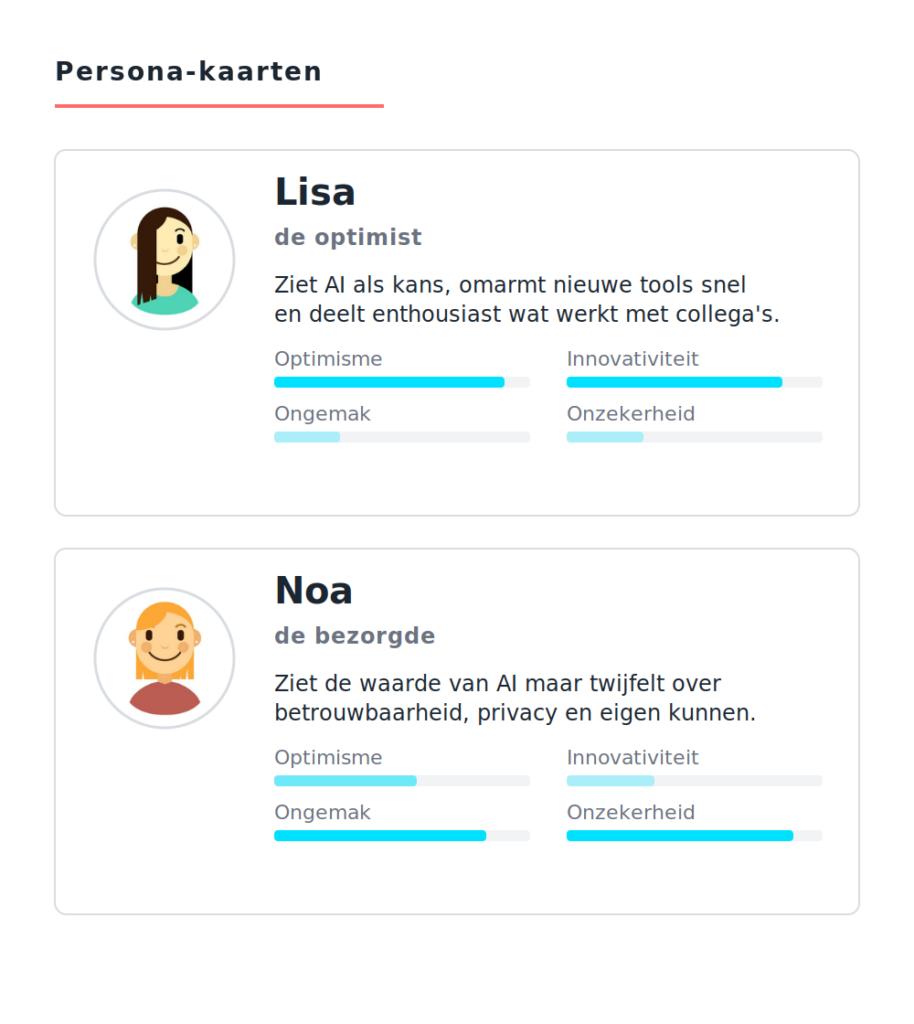
The AI Persona Scan maps employees' personal attitudes toward new technology. We measure across four dimensions that have been validated in scientific research as predictors of technology adoption: optimism (what do you expect AI to bring?), innovativeness (how eager are you to use it?), discomfort (how quickly do you feel insecure?), and uncertainty (how much confidence do you have in the outcomes?).
The scan combines an anonymous 16-item questionnaire plus 4 context questions with an algorithmic assignment to five archetypes (Lisa, Sven, Noa, Mark, Karlijn). The outcome is a distribution overview of the team or organization plus a personal profile for each employee, if they wish to link their name.
Turnaround time: 1 to 2 weeks. Completion time per employee: 8 to 12 minutes. The scan is built upon an established measurement of personal attitudes toward new technology and specifically calibrated for the AI context.
A validated 16-item questionnaire across four dimensions, plus 4 context questions (role, age group, technology affinity, years of service). Anonymous, with optional name attribution.
Optimism, innovativeness, discomfort, and uncertainty. 4 items per dimension, measured on a five-point scale.
Lisa the optimist, Sven the pragmatist, Noa the worried one, Mark the wait-and-see type, Karlijn the uncertain one. Algorithmically assigned based on score profile.
From initial intake to feedback. Including questioning, analysis, and presentation of the findings.
Organizations considering a Persona Scan typically face one or more of these issues. One or two points of recognition are usually sufficient reason to examine how your people feel about AI.
Everyone receives the same tools and the same offering, but adoption varies widely. Some employees jump right in, while others avoid it or use it in a minimal way. We often explain these differences not by the tools, but by who a person is personally.
You have invested in AI training, but the effect varies by group. The optimistic frontrunners move ahead, the anxious middle group lags behind, and the uncertain rear guard drops out. A differentiated approach works better than a one-size-fits-all, provided you know who is where.
Resistance is palpable within the organization, but you can't quite put your finger on it. Who exactly is dropping out, and why? You cannot build an approach with a general "they don't want to." A personal assessment reveals which concerns truly exist and among whom.
In every change process, you get stuck on individual dynamics. A board that wants to pick up the pace, a management team that is uncooperative, a team that keeps raising new doubts. The Persona Scan helps to objectify these dynamics and make them open for discussion without them becoming personal.
The Persona Scan is built upon an established measurement of personal attitudes toward new technology. The methodology has been used for over 25 years and has, over that period, proven predictive value for the extent to which people embrace or avoid technology. The version we use has recently been calibrated for AI in work environments.
We measure on four dimensions. Two of these are drivers (positive elements that accelerate adoption), and two are inhibitory factors (negative elements that slow down adoption). The combination determines which archetype an employee is assigned to.
A driving force. How positive is your attitude towards what AI can bring to your work and to society? Do you expect AI to ultimately do more good than harm? Does AI give you more control, flexibility, and enjoyment in your work? The higher the score, the more someone views AI as an opportunity that the organization can seize.
A driving force. How eager are you to try out new AI tools, even if there is no clear goal yet? Are you often asked for advice on new AI applications? Do you enjoy figuring out how something works without a manual? People with a high level of innovation are the natural forerunners in an organization.
A limiting factor. Do you easily feel insecure if an AI tool doesn't work as expected? Do you avoid situations where you unexpectedly have to work with AI? Do you feel that AI tools are designed for people who know more about them than you do? The higher the score, the more support someone needs to keep up.
A brake factor. Do you doubt the reliability of what AI tells you? Are you worried about what happens to your data? Do you want AI outcomes to always be verified by a human for important decisions? High uncertainty is not resistance, but a critical attitude that can actually be valuable for governance and quality control.
Based on the scores on these four dimensions, each employee is assigned to one of five archetypes. The names are fictitious; the profiles are data-driven and recognizable.
Lisa — The optimist. High on optimism and innovativeness, low on discomfort and uncertainty. Sees AI as an opportunity, embraces new tools quickly, and enthusiastically shares what works with colleagues.
Sven — The pragmatist. Average on all dimensions, with a practical mindset. Uses AI where it makes his work more effective, not out of principle or conviction.
Noa — The concerned one. Average on optimism, high on discomfort and uncertainty. Sees the value of AI but doubts reliability, privacy, and their own capabilities.
Mark — The wait-and-see type. Low on optimism and innovativeness, average on discomfort. Uses AI only when absolutely necessary, sees little urgency themselves, and waits for others to prove it.
Karlijn — The insecure one. High on discomfort and uncertainty, low on innovativeness. Feels easily overwhelmed by pace and complexity, and needs a lot of structure to keep up.
From the initial intake to the feedback, we work in four steps. The turnaround time is 1 to 2 weeks, shorter than the Team Scan and Maturity Scan. The Persona Scan is deliberately low-threshold: no interviews, only a short questionnaire and clear feedback.
In a 30 to 60-minute session, we refine the scope, target audience, and communication approach. Which teams, or the entire organization? How do we communicate the request internally? Do you want individual profiles returned to employees, or only aggregated data? Lead time: Day 1.
The questionnaire of 16 items plus 4 context questions is distributed anonymously. Completion time per employee: 8 to 12 minutes. We monitor the response and send reminders where necessary. Turnaround time: day 2 to 7.
We calculate scores per dimension, assign each respondent to a persona archetype, and analyze the distribution by team, role, or age group. For the combined Team Scan, we link the persona data to usage patterns. Turnaround time: day 8 to 10.
We present the findings in a session to the client, Management Team, or a team. The report follows in writing, including persona breakdown, dimension scores per segment, and concrete tools per archetype. Lead time: day 11 to 14.
The report operates on three levels: an overall picture of the team or organization, persona cards with typical scores and behavioral descriptions per archetype, and a section providing practical tools per archetype for managers and HR.
We do not report to the organization at the individual level, unless the employee has given explicit permission to do so. Anonymous participants view their own profile via a personal link, but the organization only sees aggregated data.
The Persona Scan report is deliberately recognizable to employees. We use names and faces that feel like colleagues, not statistical categories. This ensures that the outcome invites conversation, not defensive reactions.

The AI Maturity Scan is methodologically identical for all organization types. We tailor the sample and respondent circle to your size and context. The pillars and workflows remain the same, ensuring the outcome is comparable across organizations.
For HR teams that want to segment their L&D offerings based on actual learning needs. Mark needs different training than Lisa, and Karlijn needs yet another approach than Sven.
For change professionals who want to segment their communication, training, and support strategy. The Persona Scan is designed to align with common change frameworks.
For decision-makers who want to know who their frontrunners, middle group, and rear guard are. Helps set realistic expectations and identify the bottleneck in adoption.
For team leaders who are rolling out AI tools broadly for the first time and want to know what guidance their specific team needs. Much more meaningful than a general introductory training for everyone.
For organizations that want to demonstrate that they take AI literacy seriously. The Persona Scan plus targeted intervention per archetype is a demonstrable implementation of Article 4 of the EU AI Act.
For sectors where personal attitude towards technology strongly determines whether policy is adopted. For teachers, nurses, and doctors, segmentation based on archetype often works better than on function.
The Persona Scan, Team Scan, and Maturity Scan are three complementary instruments, each with its own measurement level. The Persona Scan looks at the person: who are you outside of your work context, and how do you feel about new technology? The Team Scan examines work behavior: what do you do with AI at work, and how do you experience it? The Maturity Scan looks at the organization as a whole.
The Persona and Team Scan are often used in combination. The Maturity Scan usually stands alone or precedes a larger transformation.
| AI Persona Scan | AI Team Scan | AI Maturity Scan | |
|---|---|---|---|
| Level | Person | Employee in a work context | Organization |
| Who fills in | Entire team or organization, anonymous | Entire team or organization, anonymous | 15 to 25 stakeholders plus 6 to 10 interviews |
| Lead time | 1 to 2 weeks | 2 to 4 weeks | 4 to 6 weeks |
| Completion time per employee | 8 to 12 minutes | 12 to 18 minutes | Varies (by stakeholder type) |
| Output | Division into 5 archetypes plus 4 dimensions | Dashboard on 9 dimensions, optional persona segmentation | Spiderweb on 7 pillars plus workflow chain |
| When do you choose this | For the segmenting change approach, or for the in-depth layer beneath the Team Scan. | For the rollout of AI tools or for training strategy | At the start of the AI strategy or executive accountability |
| More information | More information |
Are you unsure which scan is right for you, or are you considering a combination? Conducting the Persona and Team Scan simultaneously provides the richest picture for the change approach; the combination involves the same physical survey, but two layers of analysis. During an introductory meeting, we will discuss what yields the best results in your context.
8 to 12 minutes. The questionnaire consists of 16 items on a 5-point disagree-to-agree scale, plus 4 short context questions. Most employees complete it in one sitting, during a work break, or at the start of a sprint.
Yes. Individual answers are not traceable to persons by the organization, unless the employee knowingly links his or her name to receive a personal profile report. The aggregation rule is typically 5 respondents per segment before we report anything.
When the employee links a name: a personal archetype profile with scores, recognizable characteristics, and concrete tools for their own learning and work behavior. Many employees find this a pleasant and recognizable experience.
The Team Scan measures what employees do with AI in their work: usage, experience, and need. The Persona Scan measures who someone is in terms of their attitude towards technology, independent of the work context. The combination is powerful: “someone who is personally a Lisa but does little with AI in their work” is a different target group than “someone who is personally a Karlijn and does a lot, but feels insecure”.
The scan is built upon an established measurement of personal attitudes toward new technology. The methodology has been in use since 2000 and was redeveloped for digital technologies in 2015. We use a version specifically calibrated for AI in work environments, with 16 items across four dimensions.
For meaningful segmentation, we recommend a minimum of 20 respondents; for robust analysis on archetype, 50 or more. With smaller groups, the scan is primarily valuable as a conversation starter (“take a look at this image, do you recognize this”), not as a statistical statement.
Yes, although personal attitudes towards technology are relatively stable. We recommend a repeat measurement after 12 to 18 months, especially if the organization has implemented active interventions during that period to engage specific archetype groups.
An introductory meeting lasts 30 to 45 minutes and is always without obligation. We discuss your context and the issues currently at play, and we indicate whether a Maturity Scan is appropriate, whether a Team Scan is better suited, or whether another approach would yield more value.
You don't need to prepare anything in advance. An open conversation often yields more than a tightly scheduled agenda.