A scientifically substantiated measurement of how AI is used, experienced, and valued in the workplace. Not what the organization hopes, but what employees actually do, think, and need.
In 2 to 4 weeks, we map out where the real AI energy resides, where the blockages are, and which interventions are needed for which group. Anonymous, validated in practice, and repeatable.
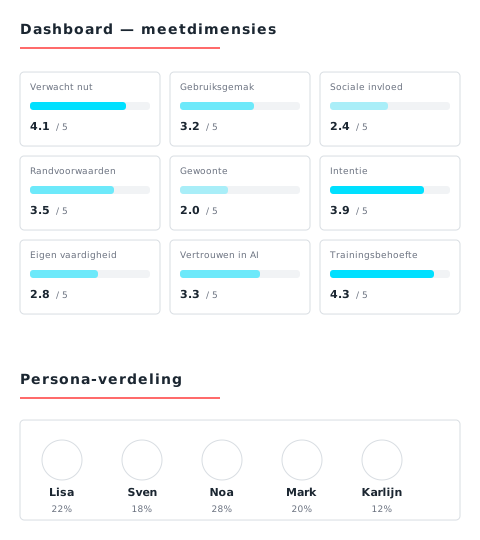
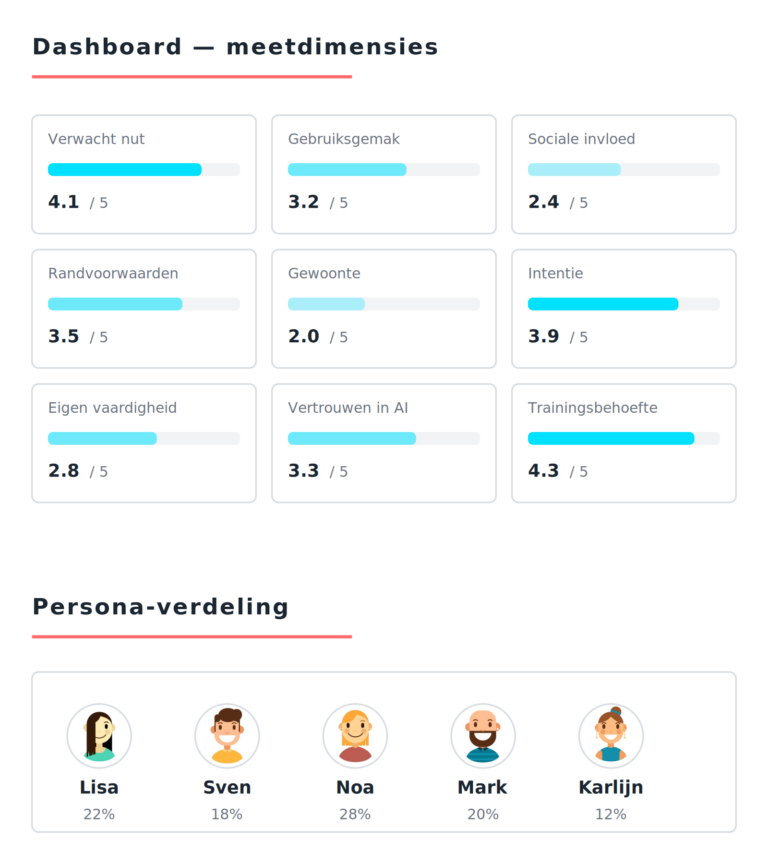
The AI Team Scan maps, at the employee level, how AI is used, experienced, valued, and desired in practice. We measure across nine dimensions that have been validated in scientific research as predictors of technology acceptance: expected utility, ease of use, social influence, preconditions, habit, intention, confidence in one's own abilities, confidence in AI, and training needs.
The scan combines an anonymous 34-item questionnaire with optional persona segmentation based on five archetypes (Lisa, Sven, Noa, Mark, and Karlijn). The outcome is a dashboard that visualizes where the organization stands, which groups require what support, and which 3 to 5 priorities make the biggest difference.
A validated questionnaire, based on established scientific models for technology adoption and supplemented with needs questions. Completion time per employee: 12 to 18 minutes.
Expected utility, ease of use, social influence, preconditions, habit, intention, confidence in one's own abilities, confidence in AI, and training need.
In a combined execution with the Persona Scan, employees are segmented into five archetypes (Lisa, Sven, Noa, Mark, Karlijn) based on their personal attitude towards new technology.
From initial intake to feedback. Including questioning, analysis, and presentation of the findings.
Organizations considering a Team Scan typically face one or more of these issues. One or two recognizable points are usually reason enough to see how AI lands in practice.
AI tools are available or are used by employees themselves, but there is no clear picture of who uses what and how often. Shadow usage and latent resistance remain invisible.
Everyone is asking for “something with AI,” but what one group needs (basic training), the other group has long since had. A scattershot approach wastes time and budget.
Since February 2025, Article 4 of the EU AI Act requires organizations to ensure AI literacy. However, without measurement, you do not know what the current level is, and therefore whether what you are doing complies.
The licenses have been purchased, but adoption is lagging behind. What is holding people back? A gut feeling tells you something, but a validated measurement says much more.
The Team Scan is built on an established scientific model for technology adoption that explains up to 70 percent of the variance in usage intent in studies. The model has recently been specifically validated for generative AI in work environments.
We group the 34 items into four domains that together form the picture: what employees expect from AI, how they use it in practice, how the surrounding culture works, and what they need to move forward.
How important do employees think AI will become for their work? For which tasks do they see added value? And do they plan to use AI more frequently in the coming period? This domain predicts whether adoption grows spontaneously or if pushing is necessary.
Which AI tools do employees use, in which contexts (personal, work, both), how often, and what impact do they experience from them? We also explicitly map shadow usage: employees who deploy their own AI tools because the organization does not yet support them.
What do colleagues and managers expect? Does the organization practically support its use? Do employees trust the outcomes of AI? And are there groups with an active preference not to use AI? This domain often explains why adoption proceeds smoothly or stalls.
How well do employees believe they can assess AI results for reliability, privacy, and ethics? Which training methods work for whom? And what preconditions (guidelines, knowledge sharing, support) do they need? This domain provides the direct tools for the intervention strategy.
In a combined execution with the Persona Scan, we plot the scores against five archetypes based on an established measurement of personal attitudes toward new technology. While the main model measures what someone thinks and does at work (situation-dependent), the personality measurement measures who someone is (relatively stable). The combination reveals what is currently at play and why.
We work in four steps, from the initial intake to the feedback. The turnaround time is 2 to 4 weeks, depending on the size of the organization and the speed at which employees complete the questionnaire.
In a 60 to 90-minute session, we refine the scope, target audience, and communication approach. Which teams or departments, optionally including persona segmentation? How do we communicate the request internally? Lead time: week 1.
The 34-item questionnaire is distributed anonymously to the entire team or the entire organization. Completion time per employee: 12 to 18 minutes. We monitor the response and send reminders where necessary. Turnaround time: week 1 to 2.
We calculate scores per dimension, map usage patterns and shadow usage, and analyze the open-ended responses. With the combined Persona Scan, additional grouping is performed based on the five archetypes. Turnaround time: weeks 2 to 3.
We present the findings to the client or Management Team in a session. The report follows in writing, including a dashboard, persona breakdown (if applicable), and 3 to 5 concrete priorities. Lead time: weeks 3 to 4.
The reporting operates on three levels. A comprehensive overview of the team or organization in a single dashboard, a breakdown per dimension with the corresponding items, and 3 to 5 concrete priorities linked to interventions.
When implemented in combination with the Persona Scan, a persona breakdown is added: how many employees fall into each of the five archetypes, and how the response differs per archetype. This provides a direct segmentation logic for training, communication, and the change approach.
In repeat measurements after 6 to 12 months, we compare the same items to statistically substantiate growth. A change per dimension is often more telling than the absolute score at a single point in time.
The Team Scan is methodologically identical for all organization types. The questionnaire is available in two language versions (Dutch and English), and we tailor the tool list and communication to the context. The dimensions remain the same so that results across teams and over time are comparable.
For SMEs that have invested in AI licenses and want to know if it yields a return. Or those still considering the step and want to see what employees think of it first.
For municipalities that wish to substantiate the literacy requirement of Article 4 of the EU AI Act, and that want to base their training policy on actual use and actual need.
For healthcare institutions introducing AI and wanting to know how it is received by different professional groups. Nurses, doctors, support staff: each with their own objections, needs, and pace.
For housing associations with significant differences between teams. Customer contact and back office use AI differently and require different support to derive value from it.
For educational institutions where widespread ChatGPT usage among teachers and support staff takes place invisibly. The Team Scan visualizes this so that you can build your policy on facts, not assumptions.
For corporates that want to segment their training and change approach instead of rolling out a one-size-fits-all solution. The combination with persona segmentation provides direct tools for implementation.
Organizations considering a Maturity Scan typically face one or more of these issues. One or two recognizable points are usually sufficient reason to assess where you stand.
| AI Team Scan | AI Maturity Scan | |
|---|---|---|
| Level | Employee in a work context | Organization |
| Who fills in | Entire team or organization, anonymous | 15 to 25 stakeholders plus 6 to 10 interviews |
| Lead time | 2 to 4 weeks | 4 to 6 weeks |
| Completion time per employee | 12 to 18 minutes | Varies (by stakeholder type) |
| Output | Dashboard on 9 dimensions, optional persona segmentation | Spiderweb on 7 pillars plus workflow chain |
| When do you choose this | For the rollout of AI tools or for training strategy | At the start of the AI strategy or executive accountability |
| More information |
Are you unsure which scan is right for you, or are you considering a combination? In an introductory meeting, we will clarify together what the most valuable first step is.
The scan measures how employees experience and use AI across nine dimensions: expected utility, ease of use, social influence, preconditions, habit, intention, confidence in one's own abilities, confidence in AI, and training needs. Additionally, we map actual usage per AI category (research, writing, note-taking, data analysis, automation, presentations), including shadow use of proprietary tools.
12 to 18 minutes. The questionnaire can be completed in one go or in multiple sessions, depending on the tool we use. We have validated the completion time in two practical implementations.
Yes. Individual answers cannot be traced back to persons. We report at the dimension level and at the segment level (role, experience, involvement) where the group is large enough to ensure anonymity, usually from 5 respondents per segment. The respondent's name is optional in the questionnaire and not mandatory.
The Team Scan measures what employees think and do at work, depending on the situation. The Persona Scan measures who someone is in terms of their attitude towards technology, which remains relatively stable regardless of the work context. In a combined execution, a respondent is assigned to one of five archetypes (Lisa, Sven, Noa, Mark, or Karlijn) based on the personality assessment, after which we can plot the scores per archetype. This provides insight into what is currently at play and why.
Yes. The scan is intentionally designed for repeat measurement. By re-assessing the same items at a later time, we can statistically substantiate shifts per dimension. Recommended interval: 6 to 12 months, shorter if active interventions have taken place.
For team statements, we recommend a minimum of 20 respondents. For robust persona segmentation, a minimum of 80 respondents is desirable. With smaller teams, we can still provide qualitative reporting, but persona segmentation and sub-segmentation are less reliable.
A dashboard with scores per dimension, an analysis of actual usage and shadow usage per AI category, optional persona breakdown across five archetypes, and 3 to 5 concrete priorities with corresponding interventions (training, frameworks, support, structure). Additionally, we present the findings verbally to the client or Management Team.
An introductory meeting lasts 30 to 45 minutes and is always without obligation. We discuss your context and the issues currently at play, and we indicate whether a Maturity Scan is appropriate, whether a Team Scan is better suited, or whether another approach would yield more value.
You don't need to prepare anything in advance. An open conversation often yields more than a tightly scheduled agenda.